Dental Implant Cost: US vs Colombia, Component by Component
A single dental implant in the United States runs roughly $3,000 to $6,000 all-in as a cash-pay patient. The same tooth, using the same implant brands, runs roughly $1,200 to $2,200 in Medellín. Those are typical 2026 ranges, not quotes, and the gap is the entire reason this site exists.
But the number people quote each other at parties is almost always wrong, because it is measuring different things. Here is what actually goes into an implant price, in both countries, and where the difference really comes from.
What "one implant" actually contains
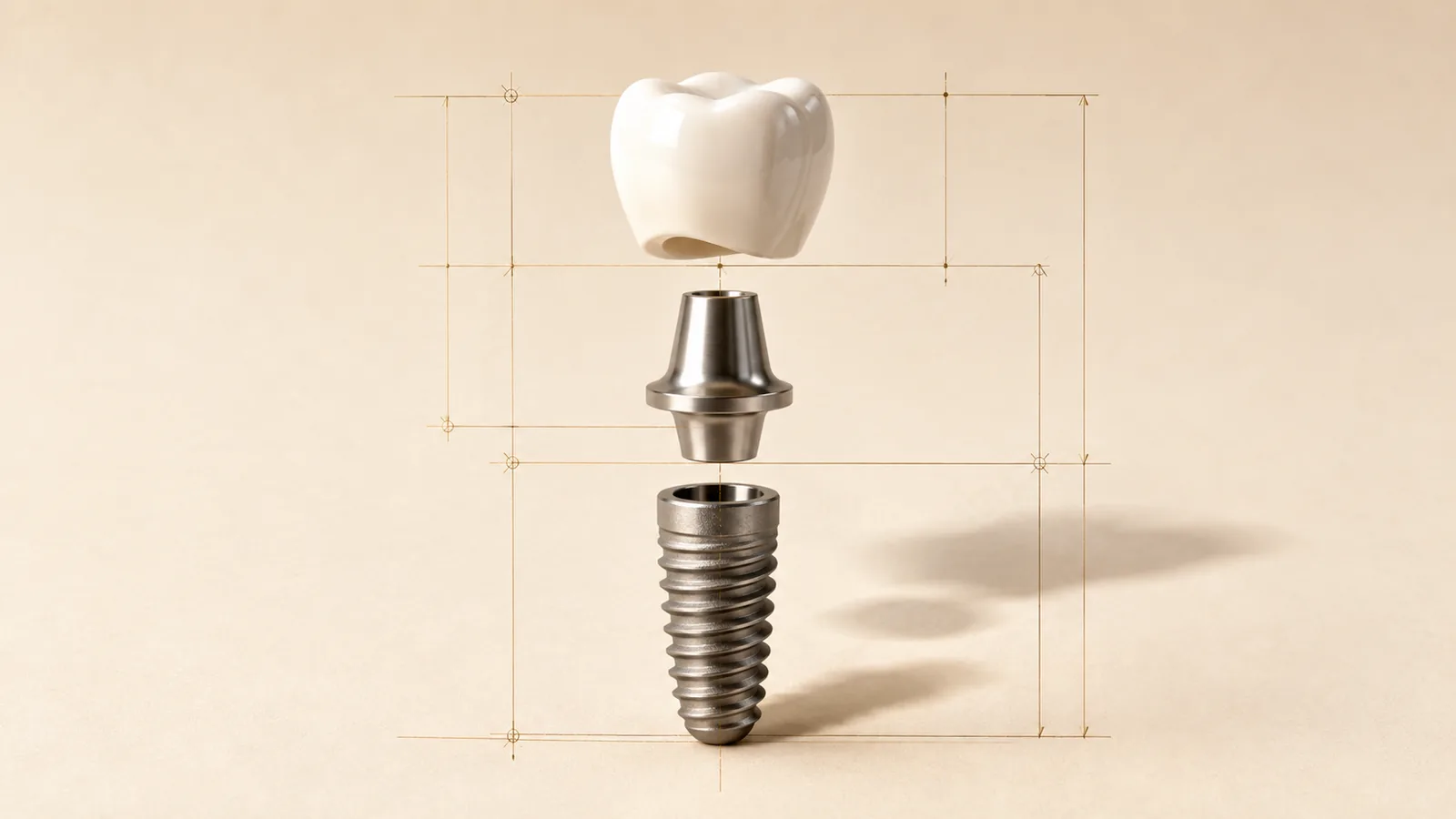
An implant is three separate objects and at least two appointments:
- The fixture — the titanium screw placed into the jawbone. In the US this component alone commonly accounts for $1,000 to $3,000 of the bill.
- The abutment — the connector that joins the fixture to the visible tooth. Typically $400 to $1,000.
- The crown — the tooth you can see. $800 to $3,000 depending on material and lab.
That is before imaging, before surgery, and before any bone grafting. The advertised "$999 implant" you have seen on a billboard is the fixture, and only the fixture. This is true in Bogotá and Budapest as much as it is in Boston.
The comparison, honestly
Single implant, all-in, midpoint pricing
Typical 2026 ranges shown at midpoint. Canadian figures converted at approximately 1 CAD = 0.73 USD.
| Component | US cash-pay | Colombia |
|---|---|---|
| Consultation, X-ray, CBCT | $150–$600 | Often bundled; $50–$180 standalone |
| Implant fixture + placement | $1,000–$3,000 | $700–$1,300 |
| Abutment | $400–$1,000 | $150–$350 |
| Crown | $800–$3,000 | $180–$450 |
| Bone graft, if needed | $1,500–$3,000 per site | $300–$1,000 per site |
| Sinus lift, if needed | $1,500–$5,000 | $600–$1,500 |
| Typical all-in, straightforward case | $3,000–$6,000 | $1,200–$2,200 |
Why is it cheaper? The answer is boring.
There is no clinical shortcut in that table. The difference is structural:
- Labour and overhead. Clinical salaries, rent and staffing costs in Medellín are a fraction of those in a US metro.
- Lab work in-house. Many Colombian clinics run their own CAD/CAM milling. In the US, lab fees are a separate outsourced line item with its own margin stacked on top.
- No insurance apparatus. A US practice carries staff whose entire job is billing, coding, pre-authorisation and claims appeals. Cash-pay clinics simply don't have that cost.
- Malpractice and regulatory overhead are dramatically lower.
What is not different: the titanium. Colombian clinics buy from the same implant catalogues sold in North America — Straumann, Nobel Biocare, Neodent, MIS, BioHorizons. Ask which system your clinic uses and get the answer in writing, because that is a real quality variable and it is one you can verify.
The part nobody advertises: implants need two trips
After the fixture is placed, it has to integrate with your jawbone — a process called osseointegration — before a final crown can be loaded onto it. That takes roughly three to six months. This is biology, not scheduling, and no clinic anywhere can compress it.
Practically, that means a standard implant case is two trips: about five days for placement, three to six months at home, then about four days for the final crown. Budget two sets of flights. Some cases qualify for immediate loading with a temporary crown, and full-arch All-on-4 protocols routinely place temporary teeth the same day — but a single implant in a healed site usually does not.
The break-even
Here is the uncomfortable part. One implant saves you roughly $2,000 to $4,000 on treatment. Two round-trip flights plus nine or ten nights of lodging across two trips runs perhaps $1,800 to $2,800. On a single tooth, the arithmetic is close enough that it is genuinely arguable, and if you value your time at anything, it may not be worth it.
The maths changes completely at volume. Three implants, or an implant plus crowns plus the root canal you have been putting off, or a full arch — the travel cost stays roughly flat while the savings scale linearly. That is why almost everyone who flies for dental work is flying for a big case, and why anyone telling you to fly for one crown is not doing the sums.
What to do before you contact anyone
- Get your panoramic X-ray. Ask your dentist to email you a copy — it is your record. Without current imaging nobody can quote you, they can only guess.
- Get a written US or Canadian quote first. You need a baseline. Ask for it itemised.
- Ask what happens if it fails. Warranty length, what's covered, whether remakes are free, whether the clinic coordinates with a dentist at home. Get it in writing before you book, not after.
- Verify the dentist. Colombian practitioners are searchable in the national ReTHUS registry. Ask for a full legal name and look them up yourself.
Full price tables for every procedure are on the prices page. If you are a veteran, the VA dental gap page covers eligibility. Canadians should start with the CDCP page.
Common questions
How much does a dental implant cost in Colombia?
Typically $1,200 to $2,200 all-in for a straightforward single-tooth case in 2026, covering the fixture, abutment and crown. Bone grafting or a sinus lift adds $300 to $1,500. These are ranges, not quotes; the real number depends on your imaging.
Are the implants the same brands used in the US?
Frequently yes. Colombian clinics buy from the same catalogues, including Straumann, Nobel Biocare, Neodent, MIS and BioHorizons. Ask your clinic to name the system in writing, because brand and model are a legitimate quality variable you can verify independently.
Do I need two trips for a dental implant?
Usually. The implant has to integrate with your jawbone for roughly three to six months before a final crown can be loaded. That is biology and it applies everywhere. Plan for about five days for placement and about four days for the final crown, with a healing gap in between.
Is one implant worth flying for?
Often not. One implant saves roughly $2,000 to $4,000 on treatment, while two round trips plus lodging can cost $1,800 to $2,800. Dental travel starts making clear financial sense above roughly $3,000 to $4,000 of treatment and becomes obvious above $10,000.
What is the $999 implant I keep seeing advertised?
The titanium fixture alone, in almost every case. It excludes the abutment, the crown, the surgery and the imaging. Always ask for the all-in price from consultation to final crown, itemised in writing, in any country.
Want this priced for your actual mouth?
Send your treatment list and a panoramic X-ray. Itemised written quotes from Medellín clinics, usually back in two to three business days.